



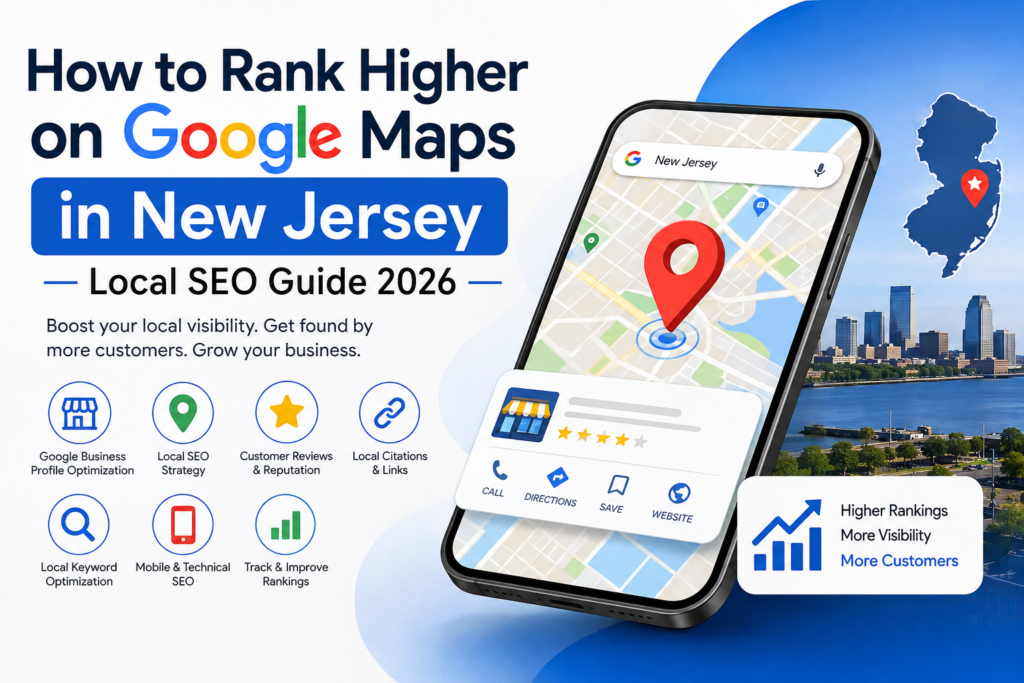
How to Rank Higher on Google Maps in New Jersey: Local SEO Guide 2026
When your business is not shown in the Google Local Pack – a map and three listing block displayed when searching “near me” queries such as “plumber near me” or “best bakery in Montclair,” you lose customers to your competitors who are being displayed in the Google Local Pack. Improving Google Maps visibility requires a certain set of activities: optimization of your Google Business Profile, maintenance of your business information consistency across the web, obtaining reviews, building local relevance with your website and content, and monitoring what works.
The following guide will cover each of the aspects in depth, specifically targeting the New Jersey market. No guarantee of #1 ranking is made in advance – no legit Local SEO Services in New Jersey can provide such a guarantee because Google doesn’t disclose the ranking algorithm, and results depend on industry and local competition. This guide offers a realistic approach to the gradual improvement of your Google Maps rankings.
How Google Maps and Local Search Visibility Work
Google officially stated the three general criteria it uses to display businesses in Local Packs – relevance, distance, and prominence. Understanding these criteria allows you to figure out why your business is displayed (or not displayed) in the Google Local Pack.
Criterion | What Does It Mean? | Why Does It Matter? |
Relevance | Degree of correlation of your Google Business Profile with the query the person has entered in Google | Completeness and correctness of the categories, service listings, and description of your business allow Google to understand what you do |
Distance | Proximity of your business or service area to the location specified in the query or associated with the search device | Presence of the location keyword in the query or search conducted from the location device makes Google consider proximity to the point more |
Prominence | Degree of popularity and recognition of your business | Amount of reviews, citations, backlinks, and overall business web presence |
No one except Google knows the exact ratio of these factors; it is different for each query and industry. The practical conclusion is that you need to consider these three factors at once, because you cannot improve the proximity, but you can work on the other two and thus compete better locally.

Why a Business May Have Good Rankings Organically but Poor Rankings in Google Maps
It is a rather common situation for New Jersey business to appear on the first page of Google for its key phrases but be poorly ranked in the Google Maps. The reason is that the Google Maps ranking system is somewhat different from the organic one.
Reasons for this situation are:
- Incomplete and outdated Google Business Profile even if the website is good
- Inconsistent business name, address, and phone number (NAP) across the Internet
- Incorrect primary category of your business
- No or too few reviews or responses to the reviews
- Mismatch of the physical address or service area in the Google Business Profile and reality
- Well-ranked website which has no local citations or local-specific content
In other words, having a strong website does not guarantee a strong Google Business Profile. Both of these elements should be optimized.
Google Business Profile Optimization: Core of Google Maps SEO
Google Business Profile optimization is the only lever you have for the direct impact on your Google Maps ranking. There are several aspects which are important for this process.
Choosing Accurate Primary and Secondary Categories
Primary category should describe the essence of your business activity, not a broader or competitive category that you would like to rank for. The roofing company should choose “Roofing contractor” rather than “Construction company,” even if the latter one is more competitive and has a higher search volume. Secondary categories can include “Gutter cleaning service” or “Siding contractor,” for instance, but they also should be accurate.
Complete and Consistent Business Information
Any field on your Google Business Profile is your opportunity to help Google (and clients) to understand what your business is: operating hours, service areas, attributes, appointment links, and messaging options. Profiles with missing information are more difficult for Google to correlate with the search queries.
NAP Consistency Across the Web
NAP means Name, Address, and Phone number. Consistent across your website, Google Business Profile, and all other directories and citations means for Google that all of these profiles belong to the same, legitimate business. Inconsistencies in NAP, such as “St.” and “Street,” or an old suite number included somewhere can confuse Google and ruin the local search rankings.
Optimization of Services and Products
Specifying the services (or products, in case of retail businesses) with proper names and short descriptions provides more information to Google regarding your business.
Writing the Effective Business Description
Describe briefly what your business does, who it serves, and which locations it covers. Do not try to fill your description with the keywords; they should be used moderately and naturally.
Photos and Up-to-date Business Profile
Business Profiles which include the photos (of the storefront, employees, completed projects, or products), which are uploaded regularly, look more alive and credible for users and Google.
Reviews and Their Response
Amount of reviews impacts the prominence, and reviews also have a direct impact on whether the potential client selects your business among others. A steady flow of genuine reviews and review response is more valuable than a burst of several reviews followed by silence.
Local Keyword Research for New Jersey Businesses
Local keyword research means to understand the phrases that people from your specific towns and counties are entering into Google Search. They usually include:
- Combination of service and location keywords (“emergency plumber Morristown,” “family dentist Bergen County”)
- “Near me” searches, which Google correlates with the location of the searching device, no matter how it is formulated
- Specific town-related phrases which may differ from how the business owner describes the own service area
Instead of guessing what people say, check the language your clients use in their reviews, questions, and phone calls – it will give you valuable information about the search phrases which keyword research tools cannot find.
Website and Landing Page Optimization for Local SEO
Your website contributes to Google Maps visibility by providing Google with the same relevance and prominence signals.
Location and Service-Area Pages
Businesses which serve multiple towns or counties in New Jersey require the special pages for each service area separately rather than one generic “service area” page. Each page should contain unique and useful information about serving that specific area, not the copy-paste of the same paragraph with the town name change.
Local Content Strategy
Creation of the blog posts, guides, resource pages related to the local topics (seasonal problems, local laws, or local concerns) will give you a possibility to demonstrate your business relevance for this area. Also, the content will provide you with the natural mentions of the towns, monuments, and regional specifics which customers use to search.
On-Page SEO Fundamentals
The title tags, meta descriptions, headers, and the body content should accurately and naturally mention both the service and the location. The page about roof repair in Essex County should look like a natural text to the user first and have an SEO structure second.
Technical SEO, Mobile Usability, and Page Speed
Many local searches are performed from the mobile devices, especially when a person searches for a nearby business. Poor usability, slow page speed, and broken links negatively impact both the customer experience and search visibility indirectly.
LocalBusiness Schema Markup
Adding LocalBusiness schema markup to your website means that search engines can find the business name, address, phone number, operating hours, and service area directly from your website. It does not guarantee any ranking for you, but removes the ambiguity and provides the same information which you provided in your Google Business Profile.
Internal Linking
The internal linking between your homepage, service pages, and location pages allows both users and search engines to better understand your site’s structure and identify the core services and service areas of your business.
Local Citations and Reputable Business Directories
A citation is any mentioning of the business name, address, and phone number in the Internet, whether it contains links or not. Providing citations in reputable and relevant directories increases your prominence and provides you with the additional NAP consistency.
Prioritize the following directories:
- Core platforms: Google Business Profile, Bing Places, and Apple Business Connect
- General directories: Better Business Bureau, Yelp, and Chamber of Commerce listings
- Industry-specific directories, relevant to your business: for example, Avvo for attorneys, Healthgrades for healthcare providers, or Angi and HomeAdvisor for home services
- Regional or New Jersey-specific directories and business associations
It is more important to get a small amount of accurate citations on well-known and relevant directories than many citations on poor-quality or irrelevant websites.
Local Link Building and Authority
Backlinks are still important for the prominence. In case of local SEO, your task is to earn backlinks from sites with a local connection. Examples of the ways to build them are:
- Sponsorship of the local event or local sports team that links back to your website
- Coverage in the local news and round-ups of the local businesses
- Development of relationships with other local businesses for mutual referral links
- Contributions to the local media or industry associations
These links are more relevant than any other links, even if there are fewer of them.
Competitor Analysis for Local SEO
Analysis of the businesses which outrank you in the Google Local Pack for your key searches may show you the practical gaps in your strategy:
- Categories used in their Google Business Profile
- Amount of reviews and when they were posted
- Comparison of their website’s service area coverage to your
- Directories and citations which they use and which you haven’t used
You shouldn’t copy exactly the approach of your competitor because the situation, history, and resources of yours may be different. You should analyze the practical opportunities which you didn’t notice yet.
Tracking Local SEO Performance
Local SEO requires a long-term effort and monitoring of the process gives you valuable feedback. Metrics that can be tracked:
- Insights of Google Business Profile (how your clients find your listing, what actions they perform (call, request directions, click your website))
- Position in the Local Pack for the selected list of target keywords
- Amount and ratings of reviews
- Website traffic and conversions from local and “near me” search phrases
- Accuracy of your citations across the selected directories
Because rankings may be different depending on the searcher’s location and device, it is more important to track the trends during several weeks/months than the ranking for a specific search on a specific date.
Local SEO for Service-Area Businesses in New Jersey
Roofers, HVAC businesses, plumbers, electricians, attorneys, healthcare providers, and other service-area businesses, which travel to their clients’ locations, rather than have a storefront to provide services have their own set of Local SEO factors.
- Service area settings are important. Google Business Profile allows you to set the service area of your business without displaying the address of the storefront, which is suitable for business without walk-in clients.
- Your location pages should correspond to the real business activities. If you provide your services in a dozen of New Jersey towns, the separate pages for each town will be more useful if they contain genuinely relevant information rather than copy-pasted templates.
- Reviews carry more weight. Service-area businesses like roofers and plumbers are selected based on the trust built almost entirely on the basis of reviews, because the client never visits the location in advance before selecting the business.
- Category accuracy avoids wasting visibility. An HVAC company should be categorized as an HVAC contractor, not general contractor, even if general contracting may seem more universal – the accuracy helps Google to match you to the correct queries.
- Licensing and credential information, consistent across the website and directories (if applicable to your industry – legal or healthcare licensing, for instance), increase both trust and prominence of your business.
How Local SEO Evolves Along with the AI-Powered Search
People’s search behavior changes now with the usage of the AI tools along with the search engines. Nobody can guarantee that your business will be mentioned or cited by ChatGPT, Google’s AI-powered search experiences, Gemini, Perplexity, or any other similar platform. But the same principles which support good Local SEO are generally valuable for good visibility in the new channels.
They usually include:
- A consistent and documented business entity: the same name, address, phone number, and services across the website, Google Business Profile, and citations
- Genuinely useful local content which answers to the real customers’ questions in the clear language
- A sufficient amount of authentic reviews which will make the business seen as authoritative
- Structured data, such as LocalBusiness schema, which allows any system to get the accurate information about your business
It is the logic of Answer Engine Optimization (AEO) and Generative Engine Optimization (GEO). The idea is to increase the clarity, consistency, and credibility of your business information so that any system (be it search engine or AI tool) will understand and potentially surface it. It is an emerging concept and no guarantee of the results, as in case of any SEO, but it is a logical extension of the good Local SEO principles. Our team has written more about this topic, in particular, how AI Visibility Services can help you with wider search presence and how AEO and SEO complement each other.
Google Maps SEO Checklist for New Jersey Businesses
Use it as the starting point for your Local SEO if you are going to either improve your existing profile or create it from scratch.
- Claim and verify your Google Business Profile if you haven’t done this already
- Select the accurate primary category and secondary categories for your business
- Complete all the fields: operating hours, attributes, service areas, appointment links
- List the services/products of your business with proper names and short descriptions
- Write the clear and concise business description without excessive use of the keywords
- Audit your NAP consistency across your website, Google Business Profile, and major directories
- Upload the recent photos and keep updating them regularly
- Set the simple process of requesting and responding to the reviews
- Create the location/service area pages on your website
- Add LocalBusiness schema markup to your website
- Verify the accuracy of your business in the core and industry-specific directories
- Pursue some locally relevant backlinks
- Review your competitors’ Google Business Profiles to identify the gaps in your own strategy
- Monitor the insights of Google Business Profile and your Local Pack ranking regularly
How Contemporary Media Group Can Help
Contemporary Media Group provides New Jersey businesses with a variety of the digital visibility services, including Local SEO Services in New Jersey, SEO strategy, website design and development, Google Ads, Meta Ads, and AI Visibility Services. If you are struggling with your Google Maps rankings or don’t have time to handle Google Business Profile optimization, citations, and local content while running your business, this is exactly what our team does.
Our approach to creating a Local SEO strategy for your company will depend on the real-life specifics of your business – service area, niche, and existing online presence. Get in touch with us at Contemporary Media Group and we’ll discuss your Google Maps presence and realistic way forward.
The period of time needed to improve your ranking will depend on your niche, the competition you face, and your starting point. For most companies, the best improvements are made over several months after their Google Business Profile is properly optimized, review-generating, and citation building is done.
Not necessarily. Businesses whose service area is limited to one or several towns or counties can create a Google Business Profile representing their service area without listing any physical addresses for it provided they do not meet their customers at a particular place.
While there is no magic number that will give you the needed ranking, the key is to maintain the flow of the reviews. The more positive reviews you manage to get, the better chances you have of appearing in Google's search results.
It helps only if you have different locations. Having duplicate or fabricated accounts is prohibited by Google and can result in the suspension of your profile account(s).
The main difference between SEO and Local SEO is the area of application. While SEO is a process that aims at improving visibility in the general organic search results, Local SEO is intended for achieving visibility in location-based searches such as Google Maps and Google Local Pack. However, most SEO methods can be used for Local SEO.