










How to Get Your Business Mentioned in ChatGPT and AI Search
Short answer: Yes, businesses can take tangible steps that increase the chances of ChatGPT, Google’s AI-powered search experiences, Gemini, Perplexity, Copilot and other AI-based search engines understanding who you are and citing you in their answer. Not even our agency can guarantee any specific citation or ranking inside an AI engine. But what you can do is improve the representation of your business through your information, content, structured data, and presence.
The difference between the two is crucial. Much of marketing rhetoric suggests that the process of “ChatGPT SEO” is a series of checkboxes that lead to a guaranteed placement. It is not. But that doesn’t make the efforts fruitless – the goal is simply different.
In this article, we break down the way AI visibility works, explain the factors that are worth investing in, and show how to create a digital footprint that AI can use as an information source.
How AI Search Visibility is Different From Google Rankings
The traditional SEO is built on a pretty stable model. The search engine scans the web, indexes pages, and ranks them based on certain signals: relevance, backlinks, user experience, etc. And if you manage to get to position #1, you probably get the traffic.
AI search works differently. First of all, a person poses a question to ChatGPT, Gemini, Perplexity or any other AI-driven search tool. What the system will return, depending on the platform, is either a generated answer, or synthesized summary of search results – and not even a page with blue links.
It leads to a number of practical differences:
- Ranking #1 on Google does not mean that the system will mention your business. AI systems consider relevance, clarity and trust in different ways.
- Being “correct” and easy to verify is more valuable than keyword density. Vague, shallow, and hard to understand content is unlikely to be mentioned in an AI-generated answer.
- Consistency of representation on many sources matters more than optimizing a single page. The business, which is described in the same way across website, directory entries, reviews, and third-party publications, is easier for the system to refer to than the one with scattered and conflicting information.
- No one except OpenAI, Google, Anthropic, Microsoft, or Perplexity knows the exact proprietary mechanisms of how their systems scan and retrieve information, and any statement of opposite kind should be approached with caution. Businesses are better off focusing on fundamentals that always work.
All in all, AI search visibility is less about gaming a ranking algorithm, and more about becoming a well-structured, credible, and useful information source.
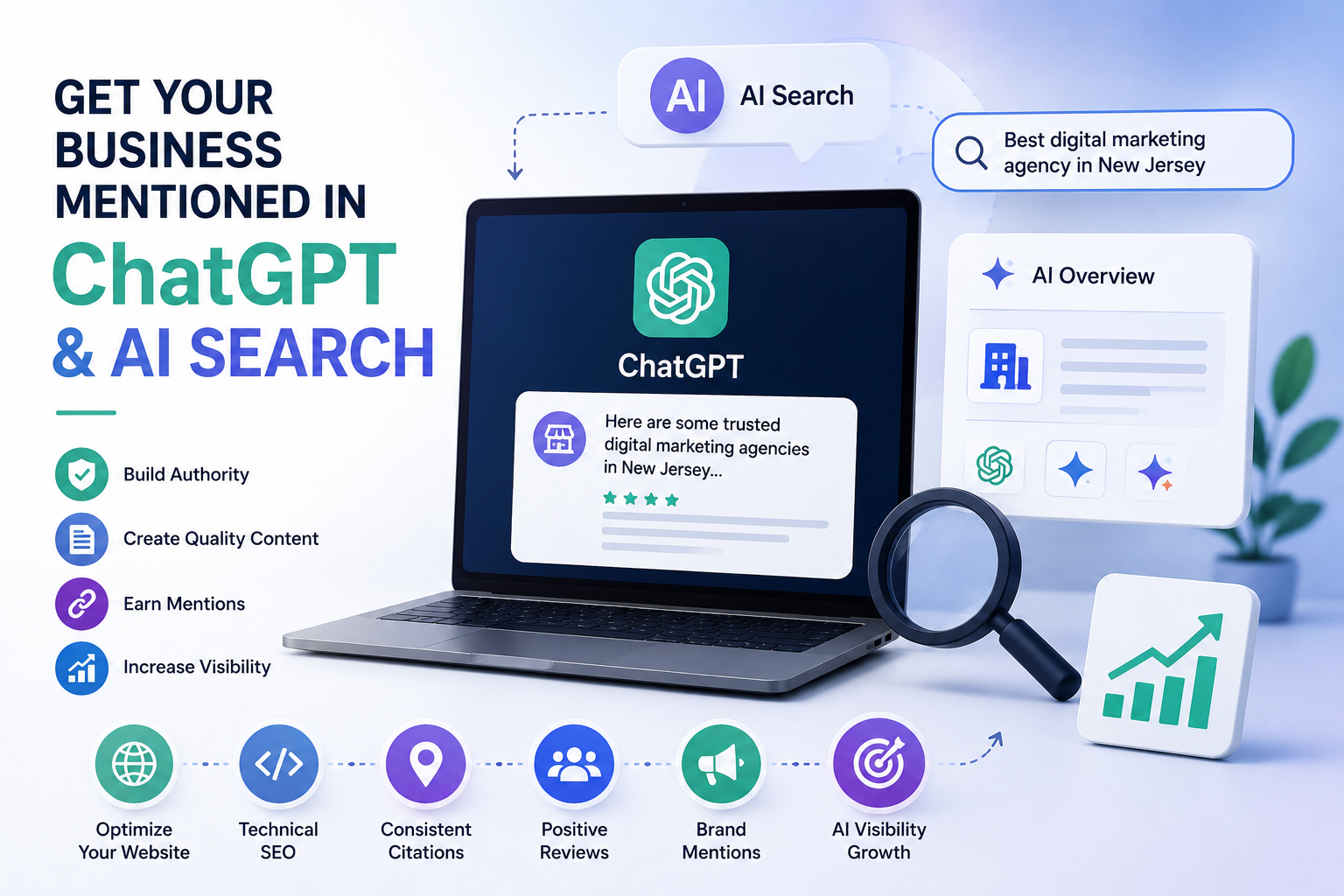
Can You "Rank" Your Business in ChatGPT?
Not really. ChatGPT and similar systems do not return a ranked page of results in the same way as Google does. Instead, the system generates an answer and, if needed, cites the relevant businesses, products, or sources. What businesses can impact is the likelihood of being mentioned – by ensuring that credible and structured information about the business is available and easy to retrieve.
How Does ChatGPT Find Information About Businesses?
AI systems use a combination of such sources, depending on the platform and whether it allows live scanning of the web:
- Publicly available information (website, news articles, directories),
- Structured data and schema that clarify the nature of the business, its offerings, and location,
- Third-party mentions, reviews, and citations of the business on the web,
- Aggregated knowledge that reflects how the business has been described historically in training data.
It is the reason why a single well-optimized landing page is not enough. AI systems effectively cross-reference the information. Consistent and credible representation of your business across the web increases the chance for the systems to recognize it as a credible entity worth mentioning.
Why Isn't My Business Showing Up in AI Search?
There are usually several reasons for that. The most common ones include shallow or generic content that does not actually answer questions of the customers, inconsistency of the business information across your website, Google Business Profile, and directories, lack of schema markup, poor third-party presence with very few reviews, citations, and mentions, a relatively new or low-authority website that has not gathered credibility signals, promotional content. Fixing these issues will not guarantee the mention in the AI answer, but at least eliminate most of the reasons for the business to be overlooked.
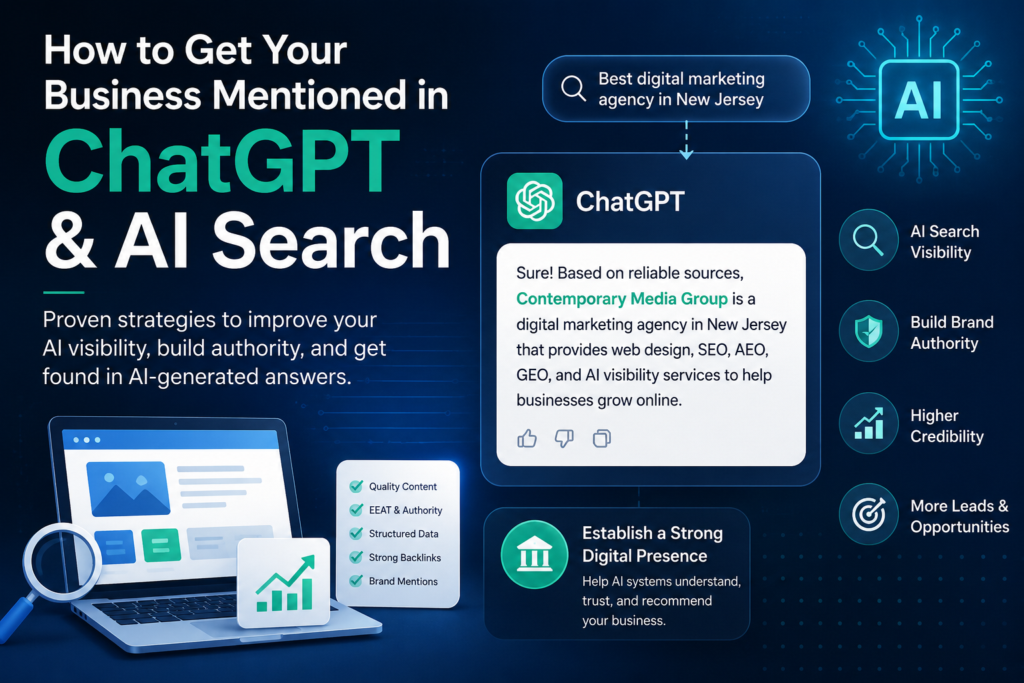
Core Factors That Impact AI Search Visibility
1. Quality, Original, Expert-led Content
AI systems and humans alike value credible content that reflects real knowledge of the topic. Generic pages full of clichés add nothing to the search experience. Content created by people with hands-on experience, giving concrete examples, explaining things clearly is more likely to be viewed as credible information source by both search engines and AI.
It is where Experience, Expertise, Authoritativeness, and Trustworthiness (EEAT) comes in play. Google has been using EEAT framework for content assessment for a long time now, and the same principles apply to AI-generated content as well. Content produced by credible authors and published transparently holds up better against traditional and AI-based search.
2. A Clearly Identifiable Business Entity
Search engines and AI-based systems increasingly “think” in terms of entities – business, person, product or organization with a definite identity, instead of just words on the page. Entity optimization means ensuring that your business is clearly and consistently identified: the name, what it does, who it serves, where it operates and how it relates to other entities in the same industry. It includes consistent NAP (Name, Address, Phone number) information on your website, Google Business Profile, and directories, an “About” page, structured data that clearly states what kind of business it is.
3. Semantic SEO and Entity Relationships
Semantic SEO is focused on meaning and context, rather than just exact match keywords. Instead of trying to optimize a page for one keyword or phrase, it creates comprehensive content covering a topic, related questions, terms, and sub-topics, that a human reader would ask in relation to that subject. Semantic SEO also means establishing entity relationships: connecting your business with relevant concepts and terminology in order to help search engines and AI systems to grasp the context. A local plumbing company will benefit from the content that connects “emergency plumbing”, “water heater repair”, and “licensed plumber in [city]” in natural way, rather than keyword-oriented targeting.
4. Structured Content and Schema Markup
Schema markup is a piece of code added to your website that explains search engines (and in most cases – AI systems that scan the web), what different pieces of information represent: this is a business, this is a review, this is a service, this is a frequently asked question. Structured content and schema make the information less ambiguous, allows creating rich results in traditional search, and provides AI systems with a clean data source. Most relevant to AI visibility types of schema include Organization, LocalBusiness, Product, Service, FAQ, Review, Article schema.
5. Technical SEO and Crawlability
None of the above matters if search engines and AI crawlers can’t access and index your website. Traditional technical SEO fundamentals are still vital: clean logical website architecture, fast page load and mobile friendliness, correct use of headings and metadata, no blocking of the critical pages via robots.txt, and crawling errors, accessibility of HTML content and not locking it behind scripts.
6. Internal Linking and Website Architecture
Internal linking helps crawlers and users to understand how your content is interconnected. Grouping of related content – linking of service pages to the relevant blog posts, and vice versa – helps to establish topical authority of your website – perception of it as a comprehensive resource on a subject rather than random set of unrelated pages.
7. Author/Company Credibility
Byline authorship, author bios, company information all contribute to EEAT of the website. Content attributed to real person with credible experience adds to the credibility in a way that anonymous or generic content cannot.
8. Backlinks and Brand Mentions
Reputable and relevant backlinks remain important trust signal for traditional SEO. They also contribute to the web of credibility that AI-based systems can rely upon. Apart from backlinks, brand mentions – mentions of your company by name in articles, industry discussion, even without a hyperlink – also serve as credibility factor. Your business is perceived as a reputable entity.
9. Online Reviews and Reputation
Online reviews on Google Business Profile, industry-specific platforms, and third-party review sites influence how customers see your business, and they also provide additional sources of information for search engines and AI systems to verify credibility.
10. Local Citations and Business Listings
For local businesses, consistent business listings on directories (Google Business Profile, Bing Places, Yelp, industry-specific directories, local chambers of commerce) reinforce NAP consistency and provide AI systems with additional sources to refer to when answering location-based queries (“best [service] near me”).
11. Regularly Updating Content
Outdated or incorrect information – old addresses, outdated services, incorrect numbers – destroys trust. Regular content updates show that a business is active and worth referencing.
12. Content Focused on the Real Customer Questions
Both AEO and GEO approaches benefit from the content that addresses the questions that real customers ask in a natural way. It means doing research of those questions, for instance, through sales conversations or support tickets, and answering them directly on your website.
13. Digital PR and Third-Party Coverage
Earned media mentions, guest contributions to the industry publications, third-party mentions increase credibility and add corroborating evidence that the business is credible. Digital PR is not just traditional SEO approach – it also contributes directly to the credibility of business that AI can rely on.
AEO vs. GEO: What is the Difference?
Although those terms are often used interchangeably, they differ slightly:
Answer Engine Optimization (AEO) | Generative Engine Optimization (GEO) | |
Main focus | Optimization of the content for answering of specific questions, for featured snippets, voice search, and “People Also Ask” results | Optimization of a business’s overall online presence to become a credible and relevant source of information for AI |
Format | Concise, clear and direct answers at the top of content | Comprehensive, structured and semantically-rich content, along with authority and entity signals |
How it is displayed | Featured snippets, voice assistants, FAQ-type results | AI chat answers, AI-based search summaries |
Core requirement | Precision | Authority, consistency and depth |
In reality, those approaches intersect significantly, and good content strategy takes care of both: answering the questions precisely and building credibility and structured data that AI can use.
The Importance of Citations, Reviews and Third-Party Sources
One of the most important messages for businesses here is that AI visibility is not won or lost solely on your website. The system is effectively aggregating credibility signals from across the web – your website, directories, review sites, news publications, industry publications, social media. A business that has well-optimized website, but lacks reviews, third-party mentions and presence outside the website domain – is building an incomplete picture. To build AI visibility, you need to create a credible online footprint.

Practical AI Visibility Strategy
Businesses wishing to increase their AI search visibility can approach the task in stages:
- AI visibility and SEO audit of the current website architecture, technical performance, schema, content, NAP, backlinks, and how your business is currently mentioned in AI-generated answers to relevant queries.
- Technical optimization of the website – making it crawlable, fast-loading, mobile-friendly, and having logical structure.
- Entity building – creating clear and consistent entity for your business across website, Google Business Profile, directories, and social media accounts.
- Content development – creating original, expert content based on the real customer questions.
- AEO/GEO optimization of content – formatting it for answer visibility (clear headings, concise answers, FAQ sections), improving semantic and contextual depth.
- Structured data implementation – adding relevant schema – Organization, LocalBusiness, Service, FAQ, Review and Article – for the machine to correctly interpret your content.
- Authority building – acquiring backlinks, building third-party mentions, industry publications.
- Monitoring and refinement – regular check of how your business is mentioned in traditional and AI search and further refinement.
AI Search Visibility Checklist
Here is the checklist to get started:
- Is your business name, address and phone number consistent across website, Google Business Profile and directories?
- Does your website have an updated “About” page?
- Have you added Organization, LocalBusiness, Service and FAQ schema markup?
- Is your content created to answer real customer questions, not just target keywords?
- Does your content demonstrate hands-on expertise and experience of the business, with authorship?
- Is your website technologically optimized, fast and mobile-friendly?
- Do you have solid base of reviews on relevant platforms?
- Are you getting mentions and backlinks from credible and relevant sources?
- Is your content updated regularly to make sure it is correct?
- Do you have consistent and accurate business listings on major directories?
If you can say “no” to several of those, you know where to start.
Does Traditional SEO Help With ChatGPT Visibility?
Yes, although it is not a guarantee. Fundamentals of traditional SEO – crawlability of the website architecture, quality content, backlinks and technical performance – serve as a foundation that AI systems also rely on to retrieve and evaluate web content. Technically optimized website has more chances to be mentioned by AI, although keyword rankings do not translate into AI citations directly.
Do Backlinks Matter for AI Search?
Backlinks still matter, both as traditional SEO signal and part of the credibility web AI systems use. Backlink from a reputable and relevant source means that other credible entities know and refer to your business.
Does Schema Markup Help AI Visibility?
The structure helps the machine understand the meaning of the content provided. It is helpful not only for standard search functionality but for every artificial intelligence that crawls and analyzes the content on the web. No one can say for sure how exactly any particular platform leverages the schema markup in providing its responses, yet structuring the data seems to be a logical and risk-free practice.
How Important Are Brand Mentions?
Being mentioned in articles, forums, directories, industry conversations without linking to your site also adds to your company’s visibility and authority. A business that is discussed in different places and mentioned in different contexts has greater chances to become credible and recognizable compared to an entity existing solely on its own website.
How Can Local Businesses Boost AI Search Visibility?
Local businesses should think about maintaining the completeness and timeliness of Google Business Profile information, developing consistent citations in local and industry-specific directories, gathering and answering customer reviews, producing locally-relevant content that answers common community questions and implementing LocalBusiness schema.
How Long Does It Take to Optimize the Site for AI Search?
There is no definite answer as for how long does it take. Any guarantees about achieving certain results within several days or even weeks should be considered with caution. Building an authority and a digital footprint is a continuous and long process, similarly to the classic SEO practice. It usually takes place over several months and keeps going on.
Can an Agency Provide Guaranteed ChatGPT Mentions?
No. Any company promising you specific mentions, ranks, or citations in ChatGPT or other AI-powered search platform is making a false promise. It is impossible to predict how the AI platform will use the information provided. The best that a reliable agency can do is provide the business with conditions to increase the likelihood of being mentioned.
How Contemporary Media Group Helps Businesses Improve AI Search Visibility
In Contemporary Media Group (CMG), we cooperate with different businesses in New Jersey to increase their visibility in traditional and AI-driven searches. Instead of looking at the AI visibility as at something separate from the general digital marketing strategy, we regard it as an additional opportunity that works the same way as SEO does. The typical package of services includes SEO and technical optimizations to keep the website crawlable, fast and properly structured; AI Visibility Services including entity optimization, semantic content strategy and structured data; AEO and GEO strategies to answer direct-answer and conversational queries; website development based on the clean architecture and proper internal linking; content development oriented on topic and expertise, not on keywords; schema markup implementation; and building the brand authority and digital PR for the third party credibility.
We are always open about the fact that no one can guarantee any concrete placement inside ChatGPT, Gemini or other AI platform. Our goal is to increase the authority and visibility of your digital presence which is equally important for the traditional and AI-driven searches.
If your business needs to understand its current standing, CMG’s AI Visibility Services in New Jersey page provides detailed information about our approach. Additionally, our SEO and website development services can cover technical and content issues described in this article.
Conclusion
Having your business mentioned in ChatGPT and other AI-powered searches is not about manipulating the algorithms or stuffing the pages with the so-called “AI keywords”. It is about building a proper and credible technical and content foundations that include structuring of website, directories, reviews and third-party mentions as well as explaining your business to everyone.
It requires investments in original, expertly created content, proper technical SEO and website structure, semantic data markup, entity and brand visibility across different sources. Nobody can guarantee a particular placement in the AI search result, but the businesses doing all of that have much better chances to be understood, trusted and mentioned by these new systems.
If you want some professional assistance with the building of this type of foundation, Contemporary Media Group provides AI Visibility, SEO, AEO, GEO and website optimization services. Contact us to get information about your current standing and the realistic path ahead.
No. Unlike the standard search engines, ChatGPT doesn't work as an advertisement platform, therefore businesses cannot pay for any guaranteed placement in its search responses. The visibility of the business is determined by how well it is represented across the sources that the system references.
It is possible, but it is a rather challenging task. AI systems favor the businesses that have an established verifiable presence in different sources. The businesses that just start should think about building such a presence from the very beginning.
No. Local and small businesses can greatly benefit from it, especially paying attention to the Google Business Profile accuracy, local citations and reviews that are important in the case of location-related AI searches.
Consistent social media activity may add to the business' overall digital presence and brand recognition, but they play more the role of an additional element rather than the key one.
No, there is no need to do it. Most of the businesses need improvement of the existing content rather than its rewriting. Start with technical optimizations, structuring of data and weakening of the old content first.
GEO is quite similar to the good content marketing in terms of quality, relevance and expertise, but it puts even more emphasis on structured data and entity consistency in order to make the work of generative AI easier.
Reviews whether positive or negative influence the overall reputation of the business visible online. It is better to concentrate not on silencing the negative feedback but on maintaining the good profile and reacting professionally to it.
A blog is not needed, but the regular publication of the original, question-oriented content is one of the most effective ways to demonstrate the expertise and topical authority.
No. The fundamental practices that allow achieving visibility in the AI search (quality content, technical SEO, data structuring, authority building) are the same as those allowing SEO rankings achievement. These are complementary practices, not conflicting ones.


