





How to Get More Local Business Enquiries with Google Ads
Most small businesses find it hard to attract a consistent flow of inquiries. The referrals are unreliable, the demand changes seasonally, and it takes time to grow rankings organically. However, there are people who live in your local area searching for services similar to yours on a daily basis and who tend to choose the first one they see and feel trust towards.
Google Ads for local businesses can be an effective solution in such a situation. Google Search Ads allow you to place your business on the top position in search results whenever a person near you searches for a particular service, such as a plumber, dentist, or roofer.
In this guide, we share the tips on how local businesses can use Google Ads to increase their number of inquiries, what mistakes can silently cost money, how to approach the budget, and how the paid search complements local SEO.
Why Google Ads Works for Local Businesses
Google Ads helps local businesses in that it serves ads to people looking for a service in a particular geographic region. There is complete control over the placement of the ads, keyword triggers and budget, as well as the measurement of which campaigns are generating phone calls, leads, and appointments.
High purchase intent: If someone is searching for “emergency electrician near me,” there is usually a need for an immediate solution.
Location targeting: Ads can be shown in your selected cities, zip codes, counties, or a radius of your choice.
Immediate visibility: The ads may show up immediately after the campaign is created, but gaining organic visibility may take months.
Measurability: Conversion tracking allows seeing which keywords and ads are bringing real inquiries.
Budget flexibility: Spending may be increased, paused, and redistributed at any time.
Targeting by services: Different services may have their own keywords, ads and budget.
To sum it all up, Google Ads may generate leads from a specific service offered in a specific location for a person who is looking for it right now.

Why Restaurant Marketing Is Important for NJ Restaurants
It goes without saying, that people do not just stumble upon a restaurant these days. Instead, they do some preliminary research first, which is done on a smartphone and usually involves searching in the immediate vicinity of the person, as well as searching right before the planned meal time.
Google Maps has become the main tool of research and choice of the place to go to because it displays everything about the restaurant – distance, opening hours, pictures, and reviews – in one place. If a certain restaurant is not displayed in this first set of Google Maps results, then the competition starts for scraps.
Local SEO for restaurants becomes important because these searches are highly location specific. Search for ‘seafood restaurant Jersey Shore’ and search for ‘seafood restaurant Bergen County’ should result in completely different set of results, and Google works hard to provide exactly this. This means, that your online presence should clearly convey the location and type of your restaurant.
The competition level is another element that plays an important role. NJ has extremely high density of restaurants in places like Hoboken and Jersey City, while even such a small market as Princeton has many restaurant options available. As far as ten restaurants are situated in a walking distance from each other, it means, that the restaurants with better visibility and reviews will win.
How to Get More Local Business Enquiries with Google Ads
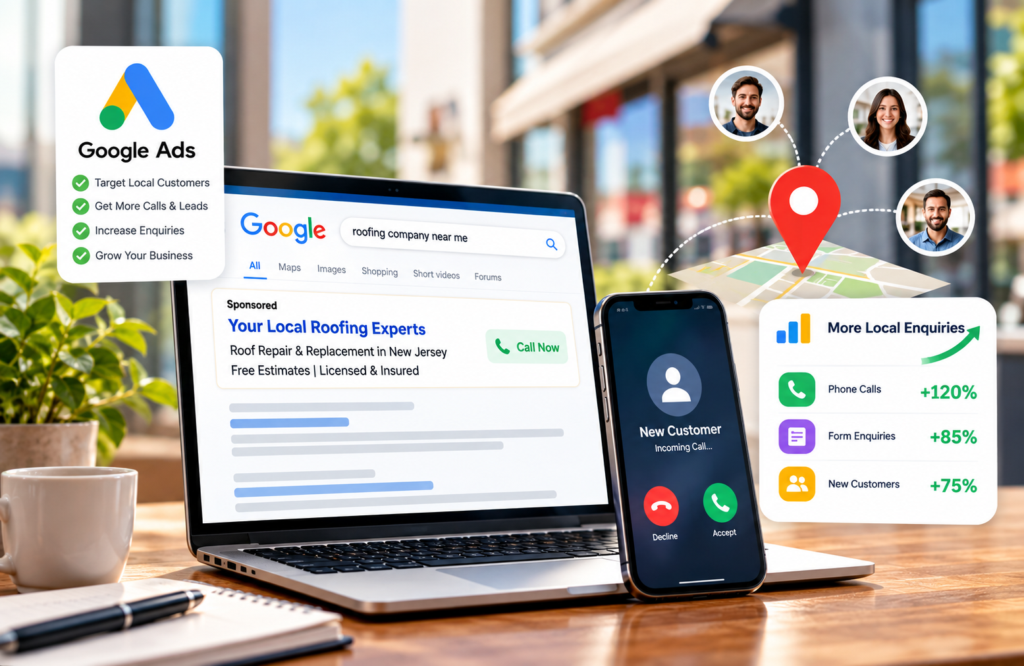
In order to increase local inquiries through Google Ads, use high intent keywords, proper location targeting, service-specific campaigns, relevant ads, landing pages, conversion tracking and optimize Google Ads based on leads and actual performance.
1. Select High-Intent Local Keywords
The ideal local keywords should be the ones that show intent to hire, purchase or book a service. Here are some examples: “plumber near me,” “roofer in New Jersey,” “dentist near me” and “digital marketing agency NJ“.
Transactional vs Informational: “how to fix a leaking pipe” is an informational keyword and the user might want to fix it on his own. “Emergency plumber Morristown” is a transactional keyword since the user intends to hire someone. Local service providers on a tight budget should focus more on transactional keywords and select suitable match types.
2. Be Specific With Location Targeting
Google Ads allows you to target cities, ZIP Codes, counties or a radius around your address. Cities & ZIP Codes targeting works for businesses that serve specific locations, Counties targeting for those with a defined service area like Morris & Sussex County, and Radius targeting for those whose services depend on travel distance.
Review location options as well. According to Google Ads Help, advertisers can target people in or regularly in a location (Presence) and also people who have expressed interest in it (Presence or interest). In most cases, presence targeting will be more secure for local businesses. It is important to review location reports periodically and exclude locations that bring only clicks.
3. Create Service-Specific Campaigns
Having multiple services in one ad group will make it impossible to create relevant ads, manage the budget and track the performance of individual services. For instance, a Central Jersey home services company can run different campaigns for roof repair, roof replacement and siding, all with different keywords, ads, landing pages and budgets.
In this way, one can increase the budget on high-value services and gain more insights from reports. The same goes for a dental practice separating the campaigns for implants, emergency care and regular checkups, or a law firm splitting the campaigns based on practice areas.
4. Make Your Ads Relevant to Local Searches
Effective local ads should answer the main question of the searcher: can this business help me, right now? Local ads usually contain the following elements:
A mention of location (such as “Serving Sussex County Homeowners”)
Benefits (like same-day service or licensed technicians)
Strong call to actions (like “Call for a Free Estimate” or “Book Online Today“)
Trust signals (like years in business, certifications or review ratings)
Offers (like a free inspection or new-patient special)
Call/Booking buttons based on how your clients prefer to contact you
It is important to keep all of these claims truthful since Google Ads policies don’t allow misleading content.
5. Send Visitors To A Specific Landing Page
Redirecting visitors from paid ads to the homepage is one of the reasons why Google Ads campaigns don’t perform well. The homepage serves different purposes, so the person searching “emergency AC repair” will have to look for information himself and probably leave the website.
Having a specific landing page increases the chances of gaining leads since the information provided will be relevant, the user won’t find any distractions and will clearly see what to do next. The landing page experience is also a factor in determining the quality of an ad according to Google. The ideal local landing page contains the following elements:
Headline matching the ad and the areas you work in
Reviews and trust signals
Tap-to-call phone number
Short form and one clear call to action
Fast mobile performance [Internal Link: Landing page design services]
6. Use Call and Lead Form Ads
Call ads add either a phone number or a call button to your ads so that mobile users can immediately call your business. Schedule call ads for business hours to ensure that every call will be answered by someone who can take the call.
Lead form ads allow users to fill out a form hosted by Google and submitted to the business, based on Google’s eligibility requirements. It reduces friction on mobile devices, however, requires prompt follow-up and quality monitoring. Location extensions tied to your Google My Business account will also show your address and distance from the customer.
7. Set Up Conversion Tracking
Conversion tracking allows you to know which keywords, ads and campaigns actually generate enquiries. Local businesses should track phone calls from ads, calls from the website, click-to-call taps, form submissions, quote requests, appointment bookings and online purchases, where applicable.
Set up a realistic minimum call duration to avoid counting hang-ups as leads. Also, import offline leads and data that shows which leads became customers, where possible. Optimization of Google Ads on leads, not clicks, is what will separate successful campaigns from busy campaigns.
8. Exclude Unnecessary Searches With Negative Keywords
Negative keywords prevent your ads from being shown when there is little chance of getting customers. Typical negative keywords include free, jobs, careers, DIY, training, salary and course.
However, negative keywords can be different for every business. A training provider wants to get “course” traffic and a company providing free estimates should not exclude the word “free”. You can build a list based on search term data.
9. Optimize Google Ads for Mobile Users
A lot of local searches occur on smartphones and often when the client needs assistance right away. Mobile friendly Google Ads should contain fast loading landing pages, click-to-call buttons, short forms, clear call to actions that are visible without heavy scrolling and mobile-first design without intrusive pop-ups. Google’s PageSpeed Insights can help you identify performance problems.
10. Monitor Search Terms and Campaign Performance
Google Ads is not something that can be managed once and never checked. Monitor the following parameters regularly:
- Search terms triggering the ads
- Cost per lead and conversion rate
- Lead quality (how many inquiries turn into customers)
- Performance by device and location
- Enquiry time of day
- Performance by keyword (lead drivers vs click drivers)
Common Google Ads Mistakes That Reduce Local Enquiries
The most frequent errors made when using Google Ads locally are usually related to targeting issues, poor tracking or poor landing pages that do not convert. They include:
- Not controlling broad targeting
- Relying on negative keyword-less campaigns
- Sending visitors to general pages
- Lack of conversion tracking
- Only focusing on clicks
- Neglecting mobile traffic
- Not optimizing Google Ad campaigns on a continuous basis
- Trying to target several services at once
- Weak calls to action
- In all probability, all of them come from the common misconception that Google Ads should be set up once and never optimized again. Loosely targeted ads waste money on irrelevant searches, while poor tracking prevents the assessment of click performance.
How Much Should a Local Business Spend on Google Ads?
There is no universal Google Ads budget for local businesses. The right amount depends on your industry, competition, average cost per click, geographic area, number of services, lead value, conversion rate, and business goals. Legal and home services keywords, for example, often cost more than many retail terms, and competitive metro areas typically cost more than smaller towns.
Illustrative example only (not a guarantee): If a business pays an average of $8 per click and 10% of visitors enquire, each lead costs about $80. If one in four leads becomes a $2,000 job, the ad cost per new customer is roughly $320. Real figures vary widely by industry, market, and campaign quality.
According to Google Ads Help, daily spend can sometimes exceed your average daily budget, but monthly charges will not exceed that budget multiplied by the average number of days in a month. Start with enough budget to gather meaningful data, then adjust based on cost per lead and lead quality.
Google Ads vs Local SEO: Which Generates More Enquiries?
Google Ads is not always better than local SEO; nor is local SEO better than Google Ads. Google Ads is quick to see results from, but once you stop paying, your traffic will dry up. Local SEO may take longer to develop, but once earned, your organic visibility will continue to produce leads.
Factor | Google Ads | Local SEO |
|---|---|---|
Speed | Visibility can begin soon after launch | Typically takes months to build |
Cost model | Pay per click while ads run | Ongoing investment; no per-click cost |
Visibility | Paid placements on search results | Organic results and the Maps local pack |
Long-term value | Stops when spending stops | Can keep generating traffic over time |
Targeting | Direct control of keywords, locations, and schedule | Shaped by relevance, distance, and prominence |
Best use case | Fast leads, new services, seasonal demand | Sustainable visibility and trust building |
How Google Ads and Local SEO Can Work Together
Google Adwords and local SEO function best when used together within the same local lead generation process. Keywords from the advertisements help to create appropriate SEO content. A good Google Business Profile is useful for ensuring visibility on Google Maps and creating location assets. A quick website with properly optimized landing pages helps to improve conversion rates for both paid and organic visitors. Search engine optimization services]
Contemporary Media Group considers PPC, local SEO, website development, and conversion rate optimization as interconnected processes in one system due to the fact that customers usually go through a number of steps before making an inquiry.
Why Local Businesses May Benefit from Professional Google Ads Management
Professional management of Google Ads can help to minimize waste and increase the quality of leads, as campaigns require continuous management and not just setup. Professional management includes campaign structure, keyword research, conversion tracking, landing page suggestions, bidding, search term analysis, budget management, reporting, and optimization.
Contemporary Media Group is located in Sparta, New Jersey and helps local and service area businesses with the management of Google Ad campaigns that are concerned with actual inquiries.
Yes, Google Ads can work for local businesses. Google Ads works by reaching users actively looking for certain services in a particular area. The results of Google Ads campaigns will depend on budget, competitiveness of the market, used keywords, landing page optimization, and conversion tracking. Optimized campaigns have a higher chance of bringing more qualified leads.
Google Ads brings more local leads through the targeting of high-intent keywords, restriction of ads to your service area and sending visitors to your landing pages. Use call assets, negative keywords, and proper conversion tracking to get more conversions from Google Ads.
There is no fixed answer to how much money a small business should put into Google Ads. The answer will be based on your industry, market competition, cost per click, service area, and the value of your customers. Calculate an acceptable cost per lead and start with a budget large enough to collect data.
SEO can increase the chances of being found because of the nearby and relevant searches. It does not guarantee a specific amount of clients, however.
Ad placements appear quickly after Google Ads campaign approval. Therefore, it is possible for some businesses to get leads just a few days or weeks after starting their campaigns. But it still takes some time to collect data and optimize targeting of Google Ads campaigns.
It depends on your business goals and timeframes. Google Ads allows getting fast visibility for generating immediate leads, while local SEO allows building organic visibility over a long period of time. Some local businesses find it beneficial to use both Google Ads and SEO for their needs.
Local businesses should use transactional keywords and keywords showing the intention to hire. Use keywords like "roof repair near me" or "roofing company in New Jersey". Combine keywords for the service and location and exclude jobs, training, do-it-yourself, and free information requests.
This probably happens due to a mismatch between search terms, ad copy, and landing page of your website. The possible reasons might be irrelevant search terms, lack of negative keywords, generic and slow landing page, poor call-to-action and incorrect conversion tracking. First of all, check search terms report and landing page.


