









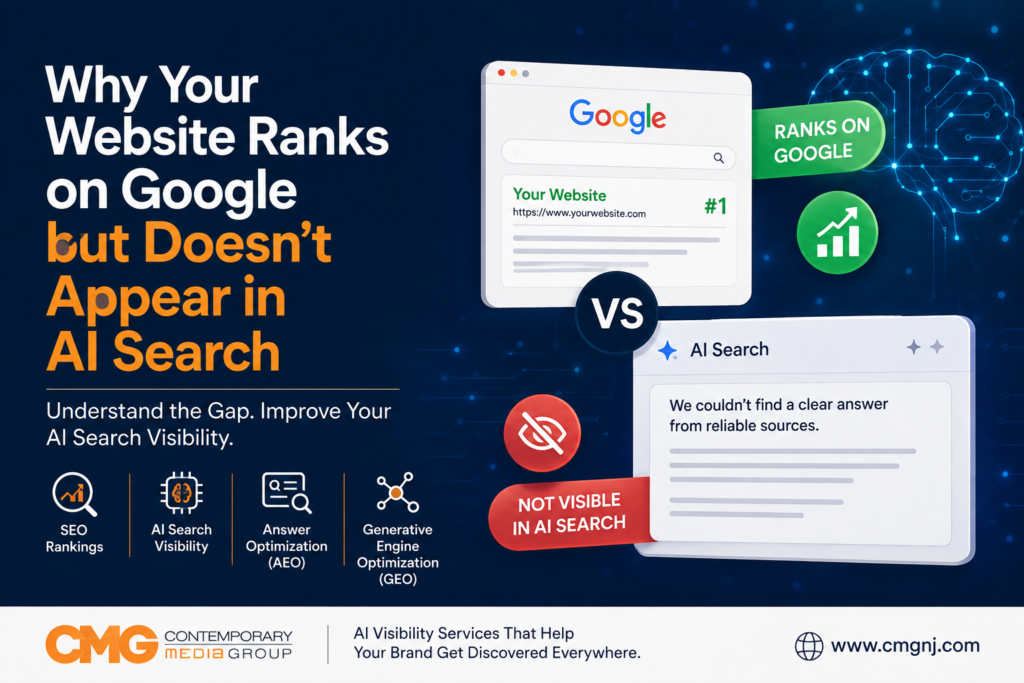
Why Your Website Ranks on Google but Doesn't Appear in AI Search
When a site ranks highly on Google but rarely appears in ChatGPT responses, Google AI Overviews, or Perplexity results, there’s nothing wrong; it just indicates that the site has not been indexed by those AI search engines yet. There is a difference between Google rankings and AI indexing because ranking high on Google means that the page is relevant and credible enough to be considered by Google’s algorithm, but it does not necessarily mean that the page will be picked by an AI system for summarizing and citation.
It becomes increasingly important every year as people use AI engines like ChatGPT, Gemini, Perplexity, or Google AI Overviews to ask their questions rather than scroll down the list of ten blue links. That means a company can be doing everything right from the point of view of traditional SEO techniques, but its pages may remain unseen by people because of that gap. The following guide explains the problem and its possible solutions.
Why Ranking on Google Doesn't Guarantee AI Search Visibility
While there is a connection between Google’s traditional ranking algorithm and AI answers, there are some differences. The traditional ranking algorithm focuses mostly on relevance and authority factors – keywords, backlinks, page experience, and performance metrics. AI Overviews, AI Mode, and other generative models introduce another factor – they need to assess the clarity and credibility of the sources that they will base their responses on.
A web page could end up on page one due to high backlink and domain authority metrics but might be still too ambiguous, long-winded, or structurally complex for an AI model to extract a reliable response. To sum up, ranking ensures you get your site considered. It does not ensure
selection.
How Traditional SEO Differs from AI Search Optimization
Search engine optimization (SEO) and AI search engine optimization (AEO/GEO) are similar in that they use the same fundamentals but are optimized for different things.
Factor | Traditional SEO | AI Search Optimization (AEO/GEO) |
Primary goal | Rank a page as high as possible in the SERP | Be selected, summarized, or cited as part of an AI-generated answer |
Unit of optimization | Individual web pages targeting keywords | Entities, topics, and clearly stated answers |
Success signal | Position, clicks, impressions | Citations, brand mentions, AI referral traffic |
Content format | Long-form pages built around target keywords | Direct, well-structured answers embedded within authoritative content |
Trust signals | Backlinks and domain authority | E-E-A-T, entity clarity, and mentions across the wider web |
This does not diminish the importance of SEO in any way. This means that AI search visibility poses extra questions to be answered beyond what SEO is supposed to do: Is this content understandable for accurate summarization? Is this brand identifiable as an authority in this particular subject matter?
How AI Search Engines Understand Websites, Brands, and Entities
The way in which AI systems conduct searches is different from the basic process of searching for a keyword. AI systems do their searches in the context of an entity. An entity refers to an individual, brand, item, or organization and the relationships it has with other topics on the entire internet and not just your website.
This implies that the AI system will come up with the concept of your company based on several factors which include your website, Google My Business Profile, review websites, industrial directory listings, news articles about your company, and any other sites talking about your business. A page cannot control all this on its own.
The Role of E-E-A-T and Topical Authority in AI Visibility
While E-E-A-T (Experience, Expertise, Authoritativeness, and Trustworthiness) has always been an important factor in SEO, it becomes especially important in AI. Essentially, an AI tool is asking itself whether it can trust the source to repeat what the source says. In other words, it is easy for an AI tool to find trustworthy information when a brand demonstrates experience and expertise, provides credible information, and is easily recognizable.
The concept of topical authority complements the E-E-A-T criteria. Having a good article on a certain topic is a good start, but having a website which provides comprehensive information on the topic with the help of interlinked articles is more beneficial for both Google and AI tools.
Semantic SEO and Entity Optimization
Semantic SEO is focused on the optimization of the topics, meanings and connections between different concepts, rather than keywords alone. Modern search engines and AI technologies are capable of understanding the context: “asphalt shingle roof longevity,” “roof replacement,” “roofing contractor,” and “roof maintenance” would all be regarded as the parts of the same topic even if not used in the same phrase.
In practice, this implies structuring the website around clear topics and subtopics, using proper terminology when describing your brand and services, and creating internal links, which illustrate the connection between the topics. Entity optimization goes even further, ensuring the consistency of information about your brand, founders, services and geographic location in order for the AI technology to recognize your company and its activities.
Structured Data and Schema Markup: Helping Machines Read Your Content
Schema markup is code placed on a webpage that marks what specific content means. It identifies this piece as a review, this piece as an FAQ, this piece as a business address, this piece as a price. While it does not affect the way a human perceives a webpage, it makes the information much clearer for search engines and AI programs.
- Organization and LocalBusiness schema allow defining your company and its location
- Article and Author schema provide information about authorship and publication useful for E-E-A-T
- FAQ and HowTo schema make the process of transferring a step-by-step or question-and-answer content much simpler
- Product and Review schema facilitate summarizing in commercial queries
Although schema markup is not required for your content to be included in an AI answer, it removes any doubts – and doubtful content can easily be skipped by an AI program.
Content Quality, Depth, Freshness, and Search Intent
Generic content can actually rank on Google, even on a website with backlinks and reputation. The same is not true with AI; the systems are picky because they want to find a specific and correct answer to the question.
- Depth: If the content is really deep into the matter and covers all the follow-up questions that will come up after the reading of that piece, it is more likely to be found by the AI system.
- Freshness: If there is some content that is related to changing topics such as prices, regulations, technologies, best practices and so on, it will be better off with frequent updates.
- Search intent: When the piece of content actually answers the question of the reader instead of just being around it, it is much more likely to be found by AI.
A simple test: if you could remove everything from the article except for the first two sentences of each section, would it answer the question of the reader? If yes, it means that the content is good for both featured snippets and AI content.

Brand Mentions, Citations, and Online Authority
The AI systems create the perception of the brand credibility based on the frequency and consistency of how this brand gets referred to somewhere else – not just backlinks. Your brand getting referenced in trade publications, comparisons, directories, forums, and review sites creates a greater web of authority around your brand in addition to what your site has to say about it.
That’s why digital PR, guest posts, and third-party mentions are still important beyond link building – because it proves that your brand is considered a credible source in its sphere.
Technical SEO and Crawlability for AI Systems
AI platforms have crawlers too like search engines have, such as Googlebot for Google as well as OpenAI’s, Perplexity’s, and various other AI platforms’ separate crawlers. Sites which are slow to load, are badly coded, block particular crawlers, or contain content hidden by heavy usage of JavaScript which cannot be parsed by crawlers will face the same problem with search engines and AI platforms.
- Semantic structure, which involves proper use of heading tags, list and paragraph tags, is easier to parse by crawlers than styled structures using divs
- Fast load time and mobile-friendly layout continue to be basic needs
- Deliberate consideration of robots.txt and crawler access should be made — allowing some AI crawlers access or blocking them is a choice, not an error
Technical SEO won’t help you craft a way in AI’s answer, but bad technical health will work against your content invisibly.
Local SEO and AI Search Visibility
For companies who service a particular city or area, local signals play an important part in how AI answers location-specific questions. It includes having a well-populated, consistent and complete Google Business Profile, good directory listing data and real reviews from customers, all of which help improve Google’s local search as well as AI answers to “Best [service] near me” or “[service] in [city]” questions.
If there are inconsistencies in names, addresses and contact number of the business across the Internet, then it becomes difficult for an AI system to identify the entity correctly.
How Google AI Overviews, AI Mode, ChatGPT, Gemini, Perplexity, and Copilot Approach Visibility
Each major AI search surface pulls information differently, which is one reason a business can appear in one and not another.
Platform | What It Primarily Draws From | Relevant Consideration |
Google AI Overviews / AI Mode | Google’s search index, ranking signals, and Knowledge Graph | Ranking well still helps, but isn’t sufficient on its own |
ChatGPT | Training data plus live web browsing and retrieval when available | Clear, well-organized content is easier to extract and summarize |
Gemini | Google’s index and Knowledge Graph, integrated with generative responses | Benefits from the same entity and structured data signals as Google Search |
Perplexity | Live web retrieval with visible source citations | Rewards content that is current, specific, and easy to cite directly |
Microsoft Copilot | Bing’s search index and web-grounded retrieval | Bing visibility and structured data both play a role |
It is impossible to say that any of these platforms will ensure that your particular business will get mentioned. It should be noted that each of these platforms is under constant development, meaning that the visibility you achieve today will not last forever.
Common Reasons a Website Ranks on Google but Stays Invisible in AI Answers
- Content is relevant but overly general or thin to reliably summarize
- Pages fail to answer the actual question in the query explicitly enough
- No data available to assist AI algorithms in understanding important details (company data, FAQ’s, authorship)
- Poor online brand presence – low number of citations and mentions on external sites
- Outdated content on an evolving subject
- Content is driven by the authority and backlinks of the domain rather than by being clear and answering the question directly
- Critical information is hidden in the middle of lengthy pages, not explicitly stated at the beginning of the section
- No question-oriented content similar to how people ask AI assistants
Practical Steps to Improve AI Search Visibility
Include a clear conclusion with supporting details at the beginning of each section – make your conclusion first, then support it
- Create FAQ sections based on the questions that your clients actually ask, with concise, self-contained answers
- Include accurate schema markup (Organization, Article, FAQ, LocalBusiness, Review) where appropriate
- Create clusters of interrelated content rather than standalone pages with no connection to other pieces
- Keep high-value, timely information current, rather than posting one-time updates that never change
- Increase your entity signals by ensuring your business information is consistent, having an up-to-date Google My Business listing, and directory listings
- Seek out actual mentions and citations from reputable third party websites within your industry
- Watch referrals and brand mentions on AI-based platforms as another metric of visibility, along with rankings
All these things increase the chances of getting recognized by an AI system and cited. None of them acts as a switch that will magically turn on AI visibility.
Is Traditional SEO Still Important in 2026?
Yes. Classic SEO serves as the basis upon which everything else is founded. Technical site optimization, quality backlinks, good on-page optimization, and high rankings are still important since many AI-driven systems are based on the same indexes and ranking factors targeted by classic SEO. AI SEO is not a substitute for classic SEO; it is rather an additional tool designed to ensure clarity and citability.
Companies that try to use AI visibility separately from classic SEO end up achieving poor results.
AI Visibility Is an Ongoing Strategy, Not a Guaranteed Ranking System
As bluntly as possible, no organization or solution can promise you that your brand will appear within responses by ChatGPT, Google’s AI Overviews, or other AI-generated answers. These services are proprietary, continuously evolving, and do not have ranking criteria like traditional search engines.
However, what you can do as a business is continue building your signals to increase the chances of AI visibility – good content, E-E-A-T, structure data, and your brand’s online presence. Approach AI visibility the same way you approach SEO – it is not a process to be done once and done forever.
Bringing It Together
SEO ranking with Google and visibility in AI answers share a common aim but require different efforts. The ranking page created without consideration of content clarity, authoritative topics, and proper links will never be included in AI Overview and quoted by ChatGPT even if the page is long and filled with keywords. To bridge this gap, one needs to focus on such elements as entity signals, authoritative topics, structured data, content clarity, and your brand’s online presence in general, rather than only on the content of your website.
Being ranked highly on Google but not visible in AI answers is a good indication of a gap between Google rankings and visibility in AI answers, and not the sign of failure of your content strategy. contemporary media group’s AI Visibility Services are specifically aimed at filling such a gap: we audit your current state in AI answers through Google, ChatGPT, Gemini, and Perplexity, and develop a structured approach to improving entity signals, content clarity, and authoritative topics.
The number of times a certain brand, website or piece of content gets shown, summarized or mentioned by AI-driven search engines including Google AI Overviews, ChatGPT, Gemini and Perplexity, regardless of their keyword ranking.
Rankings depend largely on the quality of the backlinks and domain authority while the AI-driven engines love explicit and unambiguous answers and entities signals. The page may have one of these qualities but lack the other one.
Designing of content so that it would be easily readable, citable and summarizable by answer engines and AI assistants through explicit answering, FAQ section and structured content.
Is it possible for a page to rank in Google search and at the same time
Optimization of the overall online presence of the brand, including content, structured data and entities in order to make the mentioning and citation by the generative AI engines more likely.
No, because schema markup helps machines to understand the content and extract data from it better, making the appearance more likely, but not ensuring it.
The business can improve the factors that increase the chance of ChatGPT mention, including content clarity, credible citations and consistent brand information but there is no guarantee of ChatGPT inclusion because the criteria used in selecting sources by the engine aren't known.