




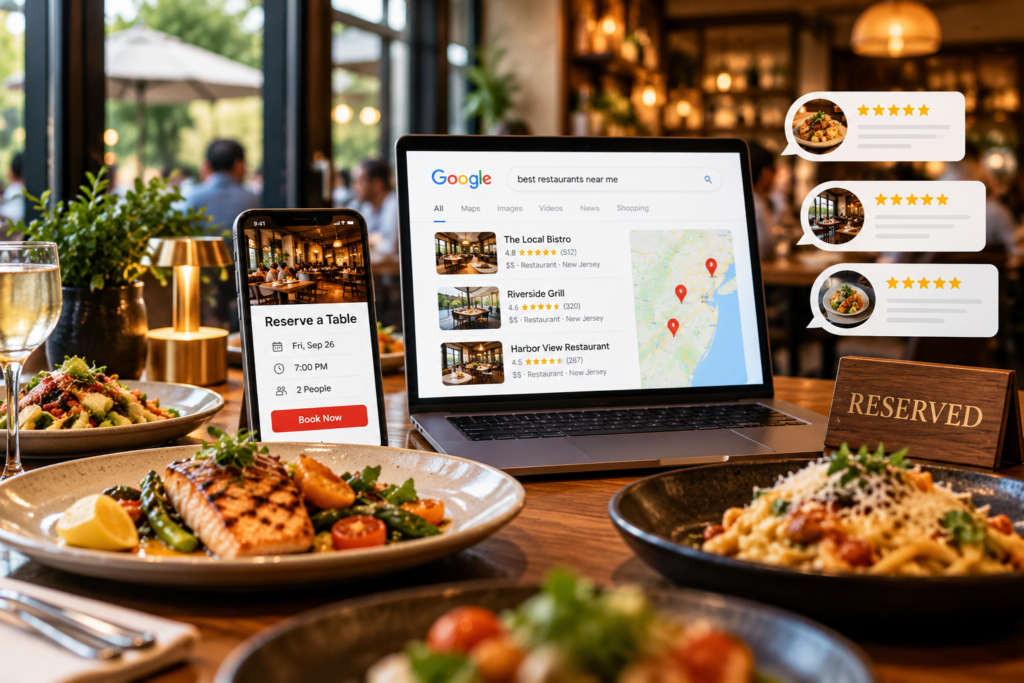
Restaurant Marketing Service in NJ: Being Found, Booked, and Reviewed
A successful NJ restaurant is not just about providing high-quality meals. In this highly competitive industry, with people comparing their experience from dining at different restaurants in Hoboken, Jersey City, Princeton, Jersey Shore, and other parts of New Jersey, you need to make sure that your business can easily be found by those who want to find it.
In order to promote their business in NJ successfully, restaurant marketers need to concentrate on the following three aspects: finding your business, booking your tables, and gaining good reviews. Local SEO and Google Business Profile optimization can provide better exposure across Google Search and Google Maps. Optimized website, detailed menu, and online booking can increase chances to get a booking. And last but not least – an effective review strategy can help you increase the credibility of your business online.
With all those components combined, NJ restaurants can increase their online presence significantly.
What Is Restaurant Marketing Service in NJ?
By the term ‘restaurant marketing Service in New Jersey‘ we mean all digital and local strategies combined, that a restaurant uses in order to attract new diners, retain existing ones, and stand out on a certain market segment (whether it is a bustling street of Jersey City or a quite suburb of Central Jersey).
In case of traditional marketing approach, the marketing efforts of a restaurant were usually connected with attracting people via foot traffic, print ads, word of mouth, and even mailers. However, in case of modern restaurant digital marketing the restaurant tries to achieve the same by using Google reviews, Instagram hashtags, and Google Maps visibility instead of conversations at a coffee shop.
Modern restaurant marketing strategy may include such elements as:
- local search visibility (in order to appear in the search results);
- Google Maps optimization;
- a website that is optimized for mobile devices;
- active and authentic social media;
- steady stream of authentic customer reviews;
- reservation and online ordering system;
- paid marketing (in order to fill the gaps during slow periods);
- conversion-oriented website.
Of course, none of these techniques will give the desired result if applied separately. Having a restaurant with great reviews, but a poorly functioning website will result in lost bookings, and vice versa.

Why Restaurant Marketing Is Important for NJ Restaurants
It goes without saying, that people do not just stumble upon a restaurant these days. Instead, they do some preliminary research first, which is done on a smartphone and usually involves searching in the immediate vicinity of the person, as well as searching right before the planned meal time.
Google Maps has become the main tool of research and choice of the place to go to because it displays everything about the restaurant – distance, opening hours, pictures, and reviews – in one place. If a certain restaurant is not displayed in this first set of Google Maps results, then the competition starts for scraps.
Local SEO for restaurants becomes important because these searches are highly location specific. Search for ‘seafood restaurant Jersey Shore’ and search for ‘seafood restaurant Bergen County’ should result in completely different set of results, and Google works hard to provide exactly this. This means, that your online presence should clearly convey the location and type of your restaurant.
The competition level is another element that plays an important role. NJ has extremely high density of restaurants in places like Hoboken and Jersey City, while even such a small market as Princeton has many restaurant options available. As far as ten restaurants are situated in a walking distance from each other, it means, that the restaurants with better visibility and reviews will win.
Restaurant Marketing Techniques That Can Help NJ Restaurants to Become Visible and Booked
1. Optimize Your Google Business Profile
Your Google Business Profile is usually the first point of contact of a potential client, before visiting your website and even learning the name of your business. The most important thing is that it is accurate and complete.
Here is the bare minimum of what you should regularly update in your profile:
- accurate and complete business name, address, and phone number (as they are listed online);
- primary and secondary categories (such as ‘Italian Restaurant’ and not just ‘Restaurant’);
- accurate hours, including holiday hours;
- up-to-date menu;
- recent photos and short videos of the restaurant and dishes;
- direct links for reservations and online ordering;
- regular Google Posts with special offers and events;
- answered Q&A section;
- reviews.
As we mentioned earlier, Google has its own guidelines for business profiles in terms of importance of completeness and accuracy for business performance.
2. Build a Local SEO Strategy
Local SEO for restaurants is an attempt to make sure that all online presence of your restaurant clearly represents it geographically and cuisine-wise. It includes:
- natural use of location-based keywords (such as ‘Italian restaurant in Hoboken’);
- targeting cuisine-plus-location and occasion-plus-location searches (such as ‘private dining Central Jersey’);
- location pages creation (provided that they add value to the website, not just a thin duplicate content);
- on-page SEO (title tags, headers, descriptions according to the cuisine and location);
- internal linking between menu, location, and about pages;
- NAP (name, address, phone) consistency across website, directories, and social profiles;
- NJ-based citation and backlinks (newspapers, chambers of commerce, food blogs).
Consistency is much more important here, than the quantity of listings.
3. Create a Mobile-Friendly Restaurant Website
The vast majority of all restaurant searches occur on smartphones, when someone is considering the restaurant where he or she will go to have lunch or dinner soon. For this reason your website should allow to:
- view the menu without downloading it as a PDF file;
- tap ‘call’ button;
- get directions to the restaurant;
- make a reservation;
- order online;
- verify hours;
- understand what kind of cuisine and location you are offering.
Lack of speed of loading, poor navigation, or menu not available until the third click will make you lose potential bookings. Clear calls-to-action, speed, and easy navigation are essential for the success of the website, not additional features.
4. Use Social Media to Show Your Restaurant Experience
Instagram, Facebook, and TikTok are most effective for restaurants, if the content appears real and not purely promotional. Pictures of dishes are still important, but short video showing something interesting (such as a busy Friday night or a preparation of a new dish) will bring more likes and increase the level of trust.
Effective types of content include:
- launch of new dishes and seasonal offers;
- behind-the-scene shots of kitchen or preparations;
- events, live music, or special holidays offers;
- reposting the content of clients (who tagged you);
Restaurant social media marketing becomes most effective when it is used as a supplementary technique to search and Maps visibility.
5. Use Paid Advertising Strategically
Google Ads and social media advertising can support your natural visibility of the restaurant in high-intent searches (‘restaurant near me’, ‘brunch in Princeton’, ‘dinner reservations Bergen County’). Paid campaigns are most helpful for filling slow days, launching new menu or fighting for attention in the saturated areas (such as Hoboken).
The key here is to define the specific goals. Your restaurant advertisement campaign should track the such metrics as phone calls, reservation clicks, directions requests, or online orders, but not just impressions. Restaurant advertising in NJ works best when it is associated with a specific action.
6. Build a True Review Strategy
Online reviews of your restaurant are one of the major trust factors that a potential client sees, before making the decision to visit it. The review strategy is relatively easy:
- ask satisfied customers to leave a review (it can be done either at the table or by sending an SMS or an e-mail);
- make the process as easy as possible (a direct link to the review form will help);
- answer positively and professionally to all reviews, no matter if they are positive or negative;
- monitor repeated complaints and use them for improving the operations.
Never try to use artificial reviews, incentivize reviews in the manner that is not allowed by the platforms, post reviews on behalf of your client or gate the review process. It violates platform policy and will harm your reputation.
7. Optimize for AI Search and Answer-Based Discovery
AI search optimization (or AEO or GEO) is aimed at making information about your restaurant understandable and usable by AI algorithms for answering queries such as ‘best brunch spot in Jersey City’.
It is about accuracy and consistency:
- consistent and well-structured content of your website;
- consistent and accurate business information wherever it appears;
- FAQ section;
- structured data/schema markup where appropriate;
- consistent and clear information about menu, cuisine, hours, and amenities;
- accuracy and consistency of information across your website, Google Business Profile, and directories.
No optimization will guarantee your participation in AI Overviews or AI generated answers, but accuracy and consistency will give you better chances.
How to Turn Restaurant Visibility into Bookings and Orders
Getting discovered is just half of the battle. Visibility without conversion is pointless.
Once the visitor comes to your website or to your Google listing, there should be clear next steps:
- reservation button;
- online ordering that does not require to register for browsing;
- click-to-call option for clients who prefer talking to someone;
- directions button;
- fast and clear to read menu;
- the ability to book private dining or event.
Conversion tracking, done by your reservation platform, ordering system, or Google Business Profile insights, will tell you what works and what does not.

How Reviews Influence Restaurant Marketing in NJ
Review affects more than just the restaurant’s reputation. It influences how the visitor decides which listing to choose, how much he or she trusts your restaurant before even visiting it, and how willing the visitor is to recommend your place after leaving the restaurant.
However, there are many elements that affect local search visibility, not just the reviews of the restaurant. Even if a restaurant has excellent reviews, but inaccurate information about business or poorly functioning website, it can underperform in search results.
Simple 30-Days Restaurant Marketing Plan for NJ
Week 1: audit your Google Business Profile and website. Correct incorrect information, such as hours, broken links, and old photos.
Week 2: tighten your local SEO (update the page titles, add location-based content, and check the NAP consistency);
Week 3: launch social media posts and develop review collection routine for recent customers;
Week 4: run a small paid campaign, set up basic conversion tracking (for phone calls, reservations, and orders).
This is not a one-time project. You will have to revisit each of these areas in a few months.
It is the combination of local SEO, Google Business Profile management, social media marketing, website optimization, reviews, and advertisement, which allows the restaurant to gain visibility in search results and then convert that visibility into bookings and orders.
You can start with an accurate and complete Google Business Profile, a mobile-friendly website, and a habit of collecting reviews.
You should maintain all information about your restaurant up to date, choose the right categories, upload new photos, and encourage genuine reviews. Also, Google takes into account the proximity and relevancy to the search, which cannot be controlled by the business.
SEO can increase the chances of being found because of the nearby and relevant searches. It does not guarantee a specific amount of clients, however.
You should ask happy customers directly to leave a review, make the process as easy as possible (by providing a link), and follow up after a good experience. You should never incentivize reviews in a way prohibited by the platforms.
Marketing costs differ depending on the mix of services (SEO, paid ads, social media marketing, and website work have different pricing). Most of the restaurants start with a modest budget and increase it depending on the results.
SEO usually takes several months, because of its reliance on consistency, and constant updates and competitiveness of the market
That depends on the provider, some include AI search optimization into the standard retainer, others charge extra for this kind of service. Considering how confusing the issue of pricing was in 2026, it would be wise to ask about AEO/GEO work inclusion into the price.


